A Short History of Clocks
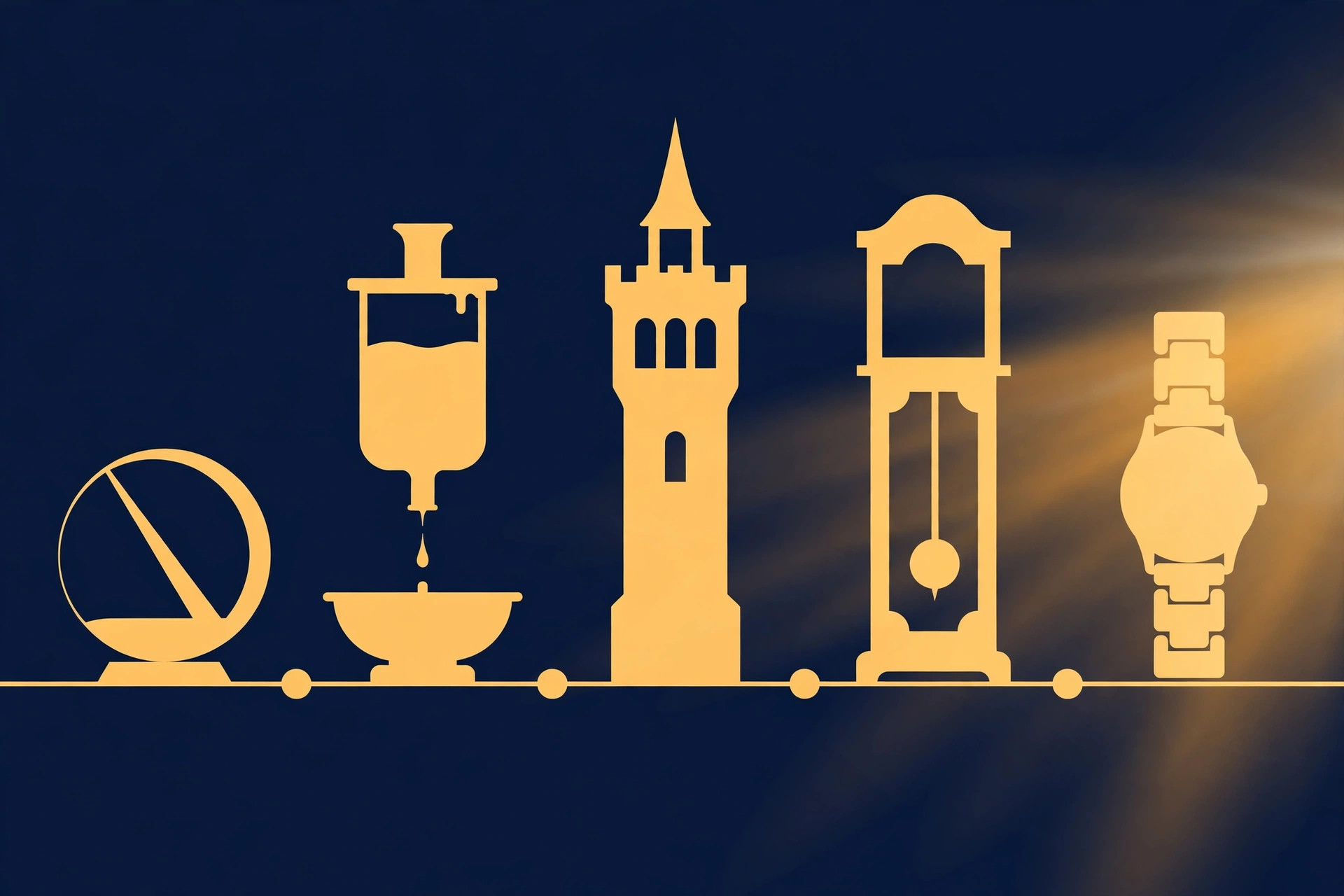
Shadow and water
The earliest clocks read nature. Sundials divided daylight by shadow, useless at night and in cloud. Water clocks filled the gap, timing by a steady drip into or out of a marked vessel, and they served temples and courts in Egypt and China for centuries. Candle clocks and hourglasses traded precision for portability. All of them shared a flaw: they measured a process, and every process drifts with temperature, wear and the maker's care. Timekeeping was local, approximate and often a matter of whose clock the town believed. The tower clocks deserve a second look, because they changed society before they told time accurately. A town with a striking clock had agreed hours: markets opened, workers started and prayers were said by the bell. Time became a public utility centuries before it became a personal possession, and the working day has been clock shaped ever since.
The mechanical leap
Weight driven clocks with escapements appeared in medieval Europe, first on towers, striking bells more than showing faces, because a town needed to hear the hour more than see it. The pendulum, in the 1650s, cut daily error from minutes to seconds and turned clocks into scientific instruments. Then came the great prize: a clock that could keep time at sea, to find longitude. John Harrison's marine chronometers of the 1700s solved it with craftsmanship so fine that the story is still told, and navigation changed forever. The wristwatch only became normal after the First World War, when soldiers brought the habit home. Within a generation, carrying the time stopped being a status symbol and became invisible, and within two more the phone absorbed the watch entirely. Each step made time more precise and less thought about, which is the usual bargain of infrastructure.
Quartz, atoms and the clock in everything
The twentieth century shrank the clock twice. Quartz watches, from the 1930s in laboratories and the 1970s on wrists, kept time by a vibrating crystal and made accuracy cheap. Atomic clocks then moved the standard into physics itself. Today the clock is invisible infrastructure: phones sync to network time, satellites broadcast time with their positions, and financial systems timestamp trades in millionths of a second. The history of clocks is the history of shrinking error, from a shadow's width to vibrations of an atom. What has never changed is the purpose: to let strangers coordinate. Every clock in the story, from the obelisk's shadow to the satellite's signal, exists so that two people who cannot see each other can still agree on when. The technology improved; the job did not.