Duration Versus Time of Day
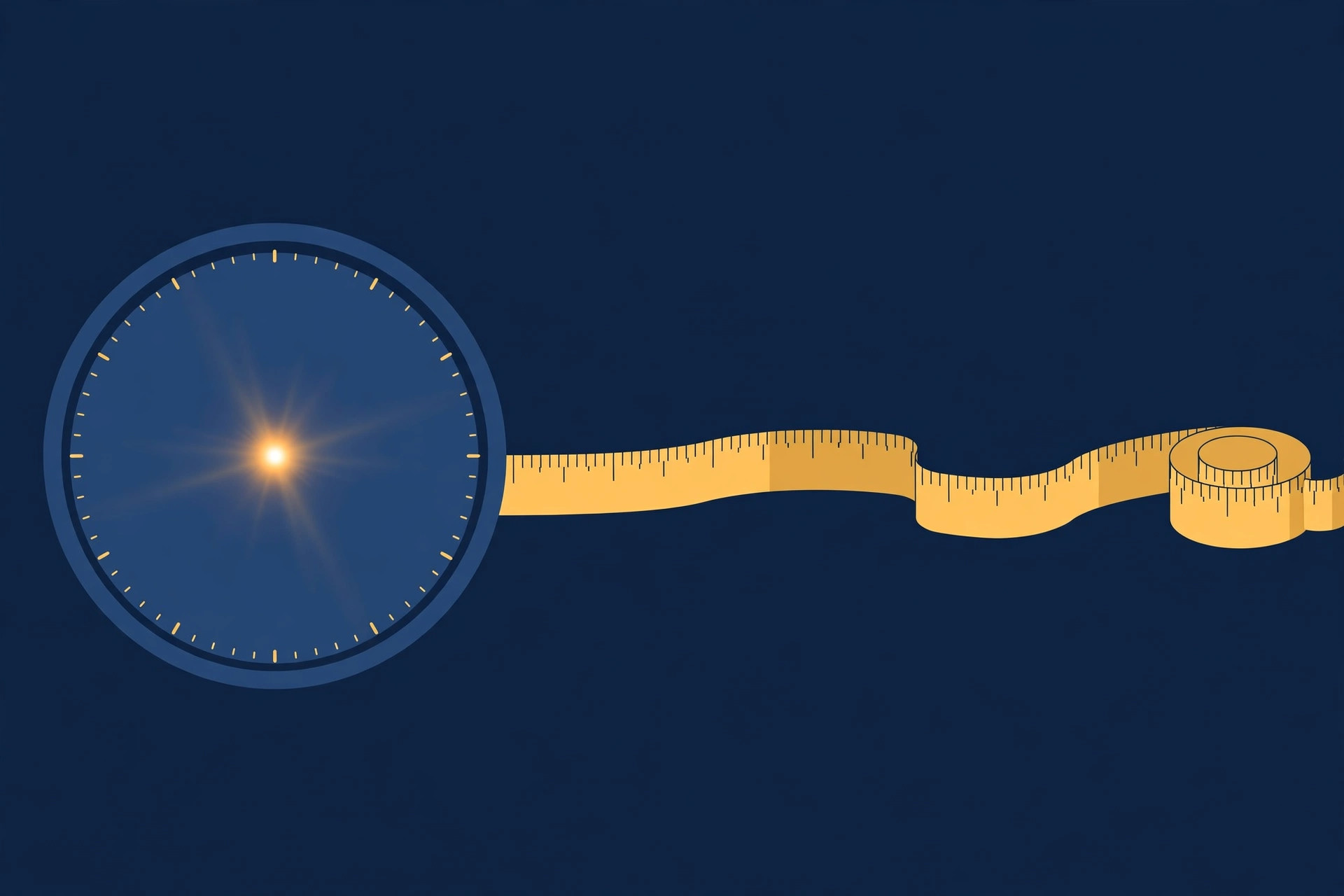
Points and lengths
A time of day is a point: 14:30 names a moment, the way a street address names a place. A duration is a length: 2 hours 45 minutes measures a stretch, the way a tape measures a wall. You can add a length to a point and get a new point, and you can subtract two points and get a length. What you cannot sensibly do is add two points together. Most time arithmetic errors come from treating a duration as if it were a clock time, or a clock time as if it were a duration, and the fix is simply naming which kind of number you are holding. The distinction also explains why clocks wrap at 24 and durations do not. A point must stay inside the day, so 25:00 collapses back to 01:00 with the day advanced. A length has no such duty: a 25 hour duration is a perfectly respectable answer, and forcing it into a clock face destroys information.
Where the confusion bites
Recording software makes the confusion easy, because it stores both kinds in the same HH:MM format. A spreadsheet cell showing 7:30 might mean half past seven in the morning or a shift of seven and a half hours, and formulas cannot tell the difference. Travel planning has the same trap: a flight listed as 14:30 plus a duration of 6:45 lands at 21:15, but only if the 14:30 is a local departure point and the arrival is wanted in the same zone. Cross a few time zones and the point changes its name while the length stays the same. Programmers meet the same idea as the difference between a timestamp and an interval, two data types that look alike and behave differently. Mixing them is such a reliable source of bugs that well designed systems refuse to add them without an explicit conversion, a strictness worth copying on paper.
A habit that prevents errors
Before any time calculation, label each number in words: departure point, duration, arrival point. Then the allowed moves become obvious. Points minus points give durations, which is how you find a shift length or a flight time. Points plus or minus durations give points, which is how you find a finish time or a latest departure. Durations plus durations give longer durations, for totals. If a sum you are about to do is not on that list, the question itself needs rephrasing, and catching that early saves the whole calculation. A quick self test: if the answer could sensibly be followed by the words o'clock, it is a point; if it could be followed by the words long, it is a duration. Ask that question of every number in a time sum and the sum will usually fix itself.