How Long Is a Lunar Month?
The month the Moon actually keeps
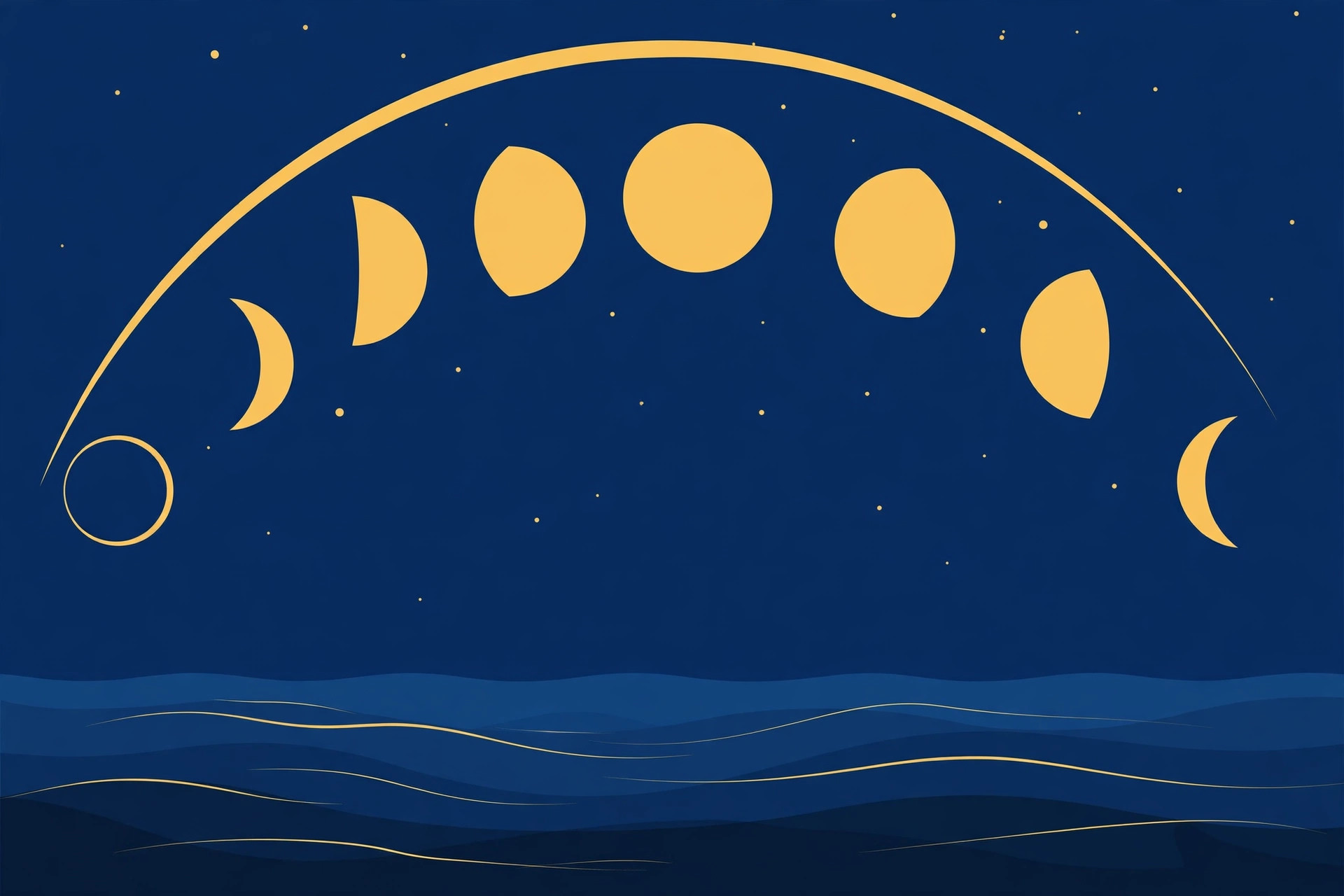
The time from one new Moon to the next is about 29 days, 12 hours and 44 minutes, called the synodic month. It is longer than the Moon's true orbit of about 27.3 days, because while the Moon circles the Earth, the Earth has moved along its own orbit, and the Moon needs extra time to return to the same alignment with the Sun. Every calendar month is a negotiation with this number: the Gregorian months of 30 and 31 days average a little over it, and true lunar calendars take it as their foundation. The Moon's phases gave us the week as well as the month, roughly: four phases of about seven days each. Neither unit survived contact with the solar year intact, but both show how much of our timekeeping began as sky watching rather than administration.
Lunar calendars and the drifting year
Twelve lunar months make about 354 days, eleven short of the solar year. Calendars built purely on the Moon therefore drift through the seasons: Ramadan, fixed in the Islamic lunar calendar, cycles through the whole solar year over about 33 years. Lunisolar calendars, including the Hebrew and traditional Chinese calendars, fix the drift by inserting a whole extra month in some years, seven times in a nineteen year cycle, which keeps festivals in their seasons while keeping months honest to the Moon. Tides follow the synodic month's halves, spring tides arriving near new and full moons, which is why tide tables are organised by the Moon's age. Coastal life still runs partly on the lunar count, whatever the calendar on the wall says.
Blue moons and month trivia
Because a synodic month is shorter than most calendar months, two full moons occasionally land in one calendar month; the second is popularly called a blue moon, happening roughly once every two to three years. February, shorter than the synodic month, can also miss a full moon entirely, as it did in 2018. These quirks are harmless, but they are a good reminder that the calendar month on the wall is a human grid laid over the sky, and the fit is approximate everywhere except in the arithmetic we impose on it. For date calculations the lunar month is mostly a caution: any system that promises months of a fixed length is describing calendar months, not moons. When a contract or a tradition says a month, ask which kind is meant before counting anything.