Why We Have 60 Minutes in an Hour
The Babylonians chose well
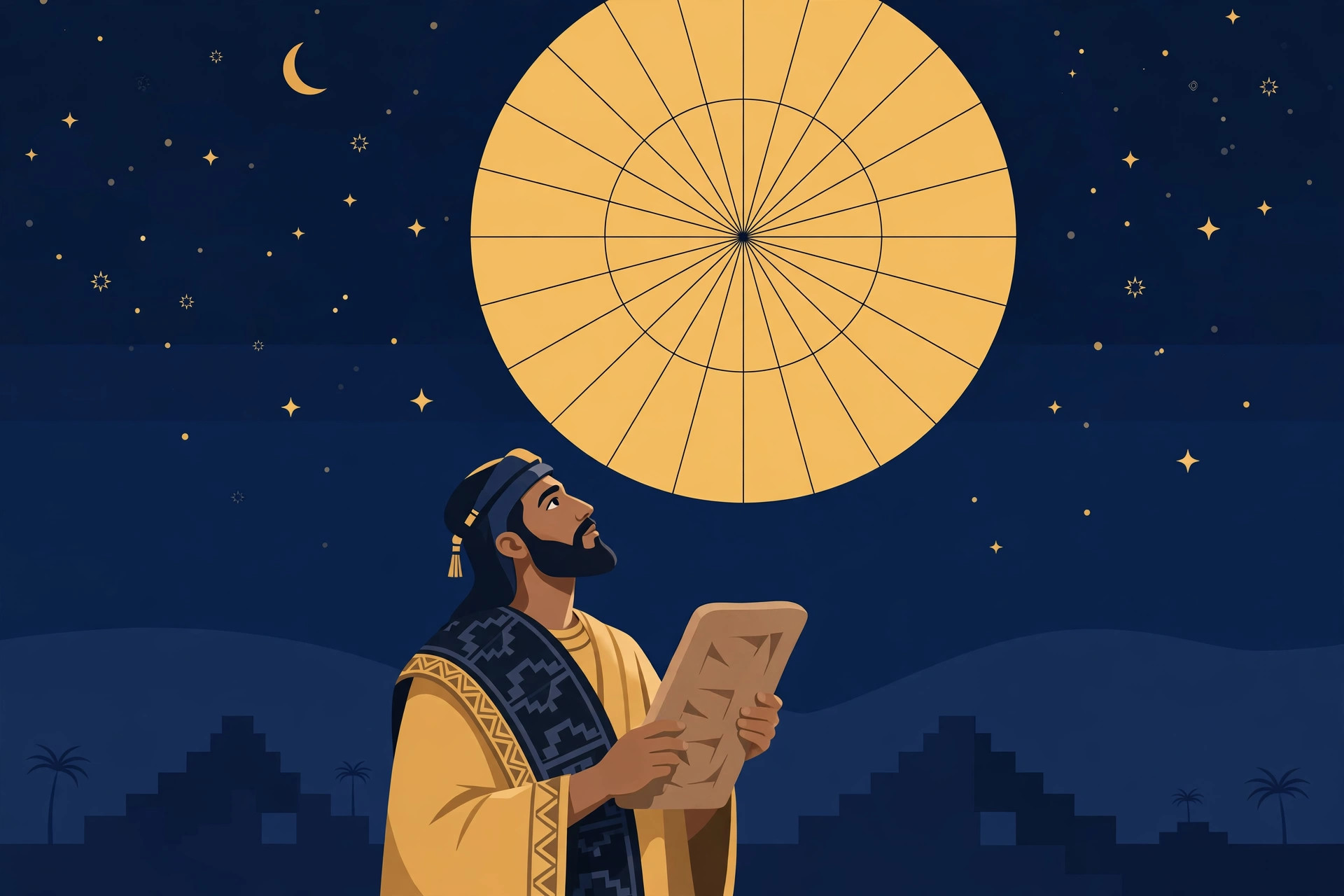
The Sumerians and Babylonians counted in base sixty, and their system survives every time you look at a clock or a protractor. Sixty was not chosen by accident: it divides evenly by 2, 3, 4, 5, 6, 10, 12, 15, 20 and 30, more divisors than any smaller number offers. Fractions of an hour or a degree come out whole far more often in base sixty than in base ten. A third of an hour is exactly twenty minutes; a third of a decimal hour is a recurring fraction. For a civilisation doing astronomy with clay tablets, that convenience was decisive. The sexagesimal habit reached us through Greek astronomy, which borrowed Babylonian methods wholesale for its star tables, and through Arabic scholarship, which preserved and refined them. By the time mechanical clocks arrived, the sixty based divisions were so embedded in astronomy that clockmakers adopted them without a serious rival.
Minutes and seconds are Latin footnotes
The words themselves tell the story of subdivision. Medieval astronomers, writing in Latin, called the first small division the pars minuta prima, the first small part, which shrank to minute. The second division was the pars minuta secunda, the second small part, which became the second. Angles inherited the same scheme, which is why a degree has sixty minutes of arc and a minute has sixty seconds of arc, and why navigation still measures position in degrees, minutes and seconds today. Modern proposals occasionally suggest decimal time again, usually for tidiness. They founder on the same rocks as the French attempt: the world's clocks, standards, software and habits are built on sixty, and the benefit of tidiness has never once outweighed the cost of changing everything at once.
Why decimal time failed
Revolutionary France tried to decimalise the day in 1793: ten hours, each of a hundred minutes, each of a hundred seconds. The clocks were built, the law was passed, and the system was dead within a few years, undone by the installed base of ordinary clocks, the week it disrupted, and the simple fact that sixty divides better than a hundred for the fractions people actually use. Base sixty has now survived about four thousand years of challengers. It is likely to survive the digital age too, because every timestamp and time standard quietly assumes it. So the minute and the second remain Babylonian. Every time a countdown reaches zero or a meeting starts on the hour, a four thousand year old counting system is doing its quiet work, and doing it well enough that nobody has ever seriously replaced it.